
Why spars matters in Optimist sailing performance?
How to choose an optimist spar set?
Hello Everyone!
It seems I underestimated the number of
participants in the Pula race in the previous post... Instead of three groups, there were actually four. I hope everyone fought to the very end in every race!
(By the way, the Pula race itself deserves a bit of statistical analysis. I’ll
conduct some research…)
However, in this post, I’d like to provide some technical background information about Optimist spars. The autumn - spring period is always a good time for technical fine-tuning, moving to the next level, or even learning new maneuvers. While it's harder these days to clearly separate preparation, qualification events, and major competitions - since one closely follows another - it’s still possible to find a few weekends for testing.
I assume there's no question that sailing is a technical sport. Everyone immediately knows that you need:
- A boat (including foils)
- A sail
- Spars - and you’re ready to hit the water.
Ten – twenty years ago (and maybe even today), this is how most people thought about sailing. Thanks to the wealth of domestic and international experience gathered over the years, we now know that achieving even minor success requires: - Proper training volume
- It’s also crucial who is in control of the whole setup - the skipper.
- (And of course, a few words could also be said about clothing.)
It’s interesting to note that beginners and even active sailors often:
- Overestimate the importance of the hull in achieving results,
- Underestimate the potential of the spars,
- Have a fairly accurate understanding of the sail, although there’s a bit of mystique surrounding its operation.
The right spar-sail combination offers tremendous potential in terms of speed and precision. Currently there are 9+1 different spar options available. Moreover, this doesn’t include all the spars from various brands. If I look through the catalogs, three different manufacturers (Optiparts, Optimax, Optimast) offer a total of 15 types of spars. Additionally, a few smaller manufacturers provide about 4–6 more types. So, we’re talking about 15–20 types of spars… without combining different brands!
Of course, it wasn’t always like this. In the 1980s (e.g., when the Eszes brothers were sailing Optimists), thanks to Köfém employees, Hungarian-made spars were commonly used by Optimist sailors.
Köfém: a factory in Székesfehérvár specializing in lightweight metals (e.g., aluminum). Many of their employees were sailors (e.g., Gusztáv Tóth, Zoltán Németh), and by combining work and hobby, they created various spars, trolleys, spibooms, etc. Of course, there were also a few foreign spars, like Optimax. Presumably, the top competitors at the time used the MKII, which was taken off the market a few years ago.
In the 1990s, even my father, Lajos Hodács, made
spars (also with Köfém's help), and Slovak spars were also available by then.
Just to clarify, we’re talking about a maximum of 2–3 spar variations! No need
to worry, these were high-quality aluminum spars.
Around the early 1990s, competitors started using
Optiparts spars, first the Silver set and then Goldspars. By the late 1990s and
early 2000s, sailing with the stronger Blackgold sets became more common.
(Today, these have been further developed, and there are three variations.)
Over time, competitors also selected from the Optimax spar family. Initially,
only the MKII and MKIII types were in use. The strongest spar, the Optimax
MKIV, was introduced in 2007. If I remember correctly, the first Hungarian
users were Fanni Péch, Benji Vadnai, and Balázs Gyapjas.
As time went on, the product range offered by
manufacturers expanded. Generally, there are more spars available for sailors
weighing 30–45 kg, while fewer options are available for those under 30 kg or
over 45 kg.
Honestly, the number of spars available today is becoming hard even for me to
keep track of. So I created a summary table, which I’m sharing with you now.
| Brand/Type | Material | Mast | Boom | Sprit | Recommended bodyweight |
| Optiparts Silver Regatta | 6082 | 45 | 40 | ||
| Optiparts Blacklite | 7075 | 45 | 40 | 26,6 | under 35kg |
| Optiparts Blackgold Medium | 7075 | 45 | 40 | 27 | 35-45kg |
| Optiparts Blackgold Power | 7075 | 45 | 45 | 29 | over 45kg |
| Optiparts Blackmax | 7075 | 45 | 55 | 29 | over 45kg |
| Optimax MKIII Flex | Lanurep | 45 | 40 | 26,6 | under 35kg |
| Optimax MKIII | Lanurep | 45 | 40 | 27 | 35-45kg |
| Optimax MKIV | Lanurep | 45 | 45 | 29 | over 45kg |
| Optimast Black | 7095 T6 / sprit7025 | 45 | 45 | 28 | over 40kg |
| Optimast Red | 7075/ sprit 7095 | 45 | 45 | 26 | over 35kg |
| Optimast Red Flex | 7025 / boom and sprit 7075 | 45 | 40 | 26 | over 30kg |
| Optimast Blue | 7020 / sprit 7025 | 45 | 40 | 26 | over 20kg |
| Optimast Green | 6082 | 45 | 40 | 28 | 25-45kg |
The main differences between spars lie in the materials used, wall thickness, and anodization. These factors are combined to create each product line; for example, with stronger materials, slightly thinner walls are used. Naturally, manufacturers don’t produce spars randomly; strict class rules (CR 3.5) apply to them as well (length, diameter, etc.).
From the table, you can see that masts all have a diameter
of 45 mm, while booms come in 40, 45, and 55 mm - although 32 mm
booms were used in the past.
Interestingly, many sailors don’t specifically focus on the sprit pole, even though there
are significant differences in terms of diameter and wall thickness. Fortunately, the approach to selecting equipment is slowly but surely changing
in a positive direction.
There are trends and theories in spar usage that change over time. Basically, there are two main theories:
- As a sailor's weight and physical strength increase, they are typically given stiffer spars.
- Choosing a slightly more flexible spar relative to the sailor’s weight allows the sail's leech to "work" more effectively.
Which is better? I won’t take a stand. Everyone
believes what they want, and it’s not necessarily possible to calculate the
best choice mathematically.
This is because spar selection is influenced by multiple factors:
- Body weight
- Physical endurance
- Sailing skill and technicl ability
- Sailing waters (wave conditions)
- Sail design (shape, entry point, radial vs. cross-cut, etc.)
Experience with different spars also plays a significant role in the decision-making process!
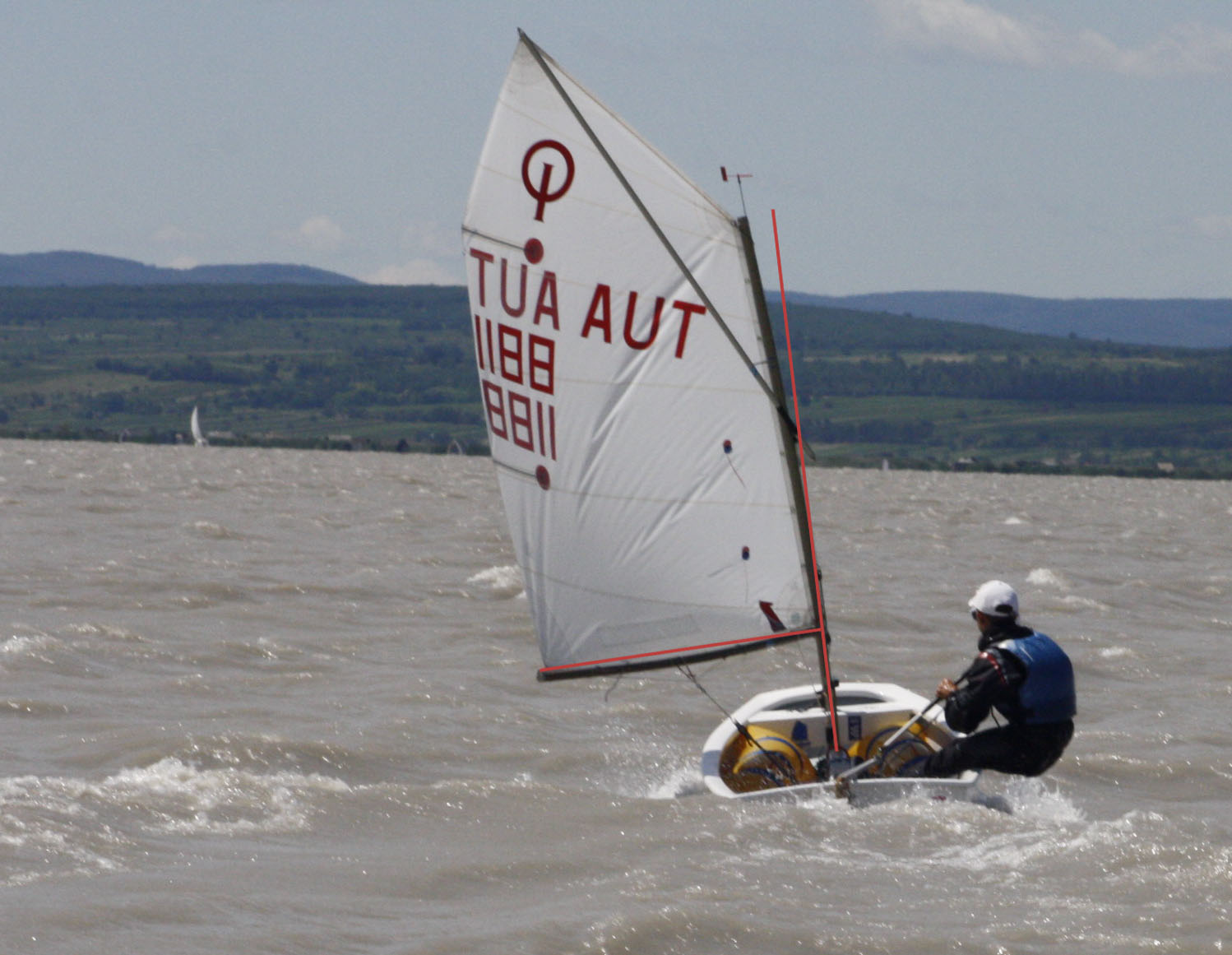
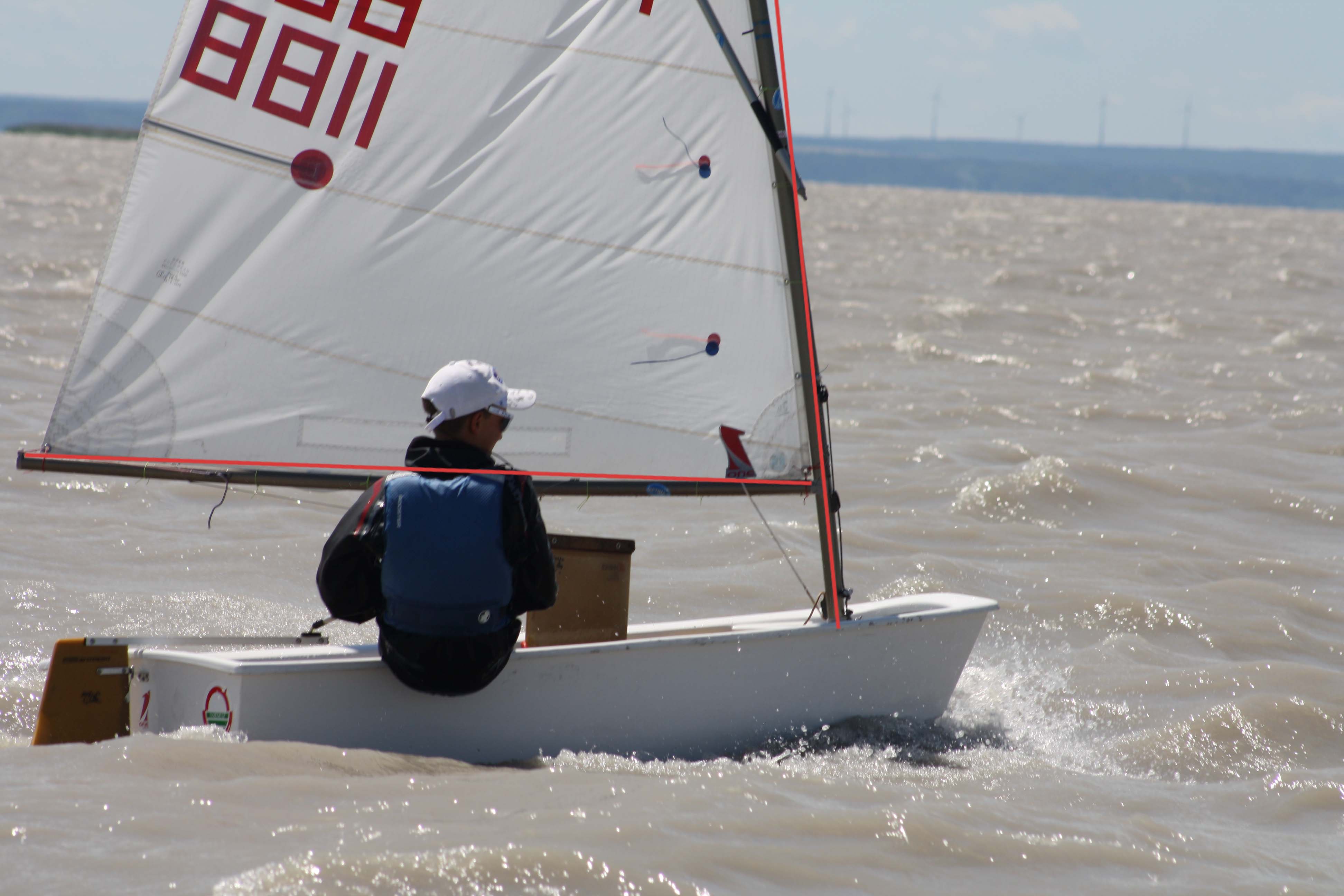
Personally, my experience aligns more with the first theory. Take a look at the attached picture. Roman, a roughly 45 kg sailor, used a medium-stiff spar. During a strong wind training session, the excessive bending of the spar was noticeable, and I thought Roman was losing too much energy—i.e., speed and precision. In my opinion, he couldn’t fully leverage his physical strength advantage in strong winds.
It took nearly two months to convince his parents to change the spar. Naturally, they received more information
supporting the second theory, which further complicated the decision. Finally,
we fitted Roman with a stiffer spar (Optimast Black)... and lo and behold! He
still handles strong winds well, although he has to work harder, but his speed
has increased. (The change was challenging because it happened mid-season and not during the autumn-spring period.)
The new boom and spritpole are visibly stronger (they bend less) compared to the previous
ones, while the mast is slightly stiffer yet retains its dynamism.
The picture shows his old spar.
Of course, this is just one example and hte opposite scenarios can also occur. Even within my team, I’ve had younger sailors who switched from inherited stiff spars to softer ones, or we replaced just a boom or gaff.
As I mentioned earlier, multiple factors should be considered when choosing a spar. For example, we wouldn’t have changed Roman’s spar if his physical fitness and boat-handling skills weren’t up to par.
Summary: Today, many
spars are available to competitors, so it’s worth selecting carefully,
considering multiple factors, especially if the goal is higher-level
international participation. A developing sailor can achieve their
goals more effectively with the right spar setup, or even just a single element replacement,
because spars have more potential than you might think! 😉
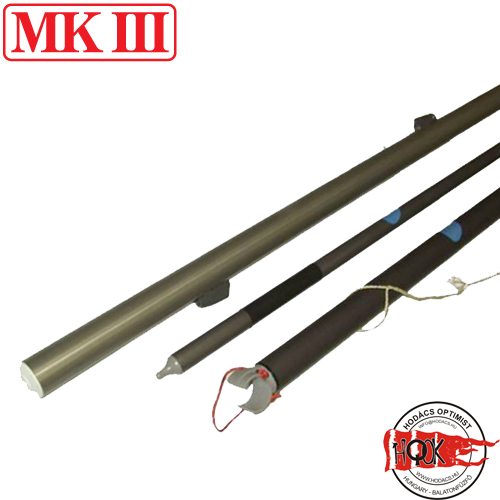
This optimist spar set from Optimax spars is for midweight optimist sailors between 35-45kg. Complete set of optimist rig with following items: - Optimax MK3 mast - Optimax MK4 boom - 45mm - Optimax MK3 sprit (if no choice)For the same price the sprit choice is yours, just write it in the order comment: MK3/MK3Flex/MK3Hyperflex Also inclusive rigging pack with: - 2x Nylon top pins - 1x Harken ball bearing hook-in block - 1x Windesign wind indicator PRO - 1x Windesign 25 mm low friction ring - 1x Nylon sprit adjuster handle - 1x 3 mm Dyneema halyard line - 1x 4 mm halyard line - 5x 2.2 mm tack lines - 12x 1.2 mm double lacing lines - 1x Deck collar with mast sleeve.
This optimist spar set from Optimax spars is for midweight optimist sailors 35-45kg. Complete set of optimist rig with following items: - Optimax MK3 mast - Optimax MK4 boom - 45mm - Optimax MK3 sprit (as standard, or choose one )For the same price the sprit choice is yours, just write it in the order comment: MK3/MK3Flex/MK3Hyperflex Also inclusive rigging pack with: - 2x Nylon top pins - 1x Harken ball bearing hook-in block - 1x Windesign wind indicator PRO - 1x Windesign 25 mm low friction ring - 1x Nylon sprit adjuster handle - 1x 3 mm Dyneema halyard line - 1x 4 mm halyard line - 5x 2.2 mm tack lines - 12x 1.2 mm double lacing lines - 1x Deck collar with mast sleeve.
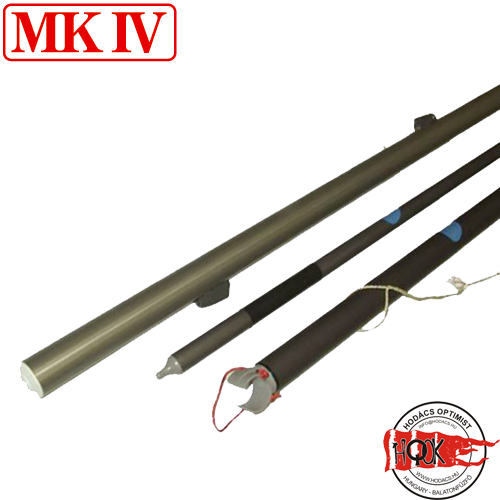
The Optimax MK4 Spar Set for Optimist dinghies is engineered for sailors above 45 kg who demand maximum performance. Constructed from superior Lanurep spacecraft alloy with a hard-anodised dark grey finish, the set includes the MK4 mast, a 45 mm boom and the MK3 27 mm sprit. Supplied complete with a premium rigging pack featuring Harken ball-bearing hook-in block, Windesign low-friction ring and PRO wind indicator, this rig delivers stiffness, precision and reliability in racing conditions. Complete set of optimist rig with following items: - Optimax MK4 mast - Optimax MK4 boom - 45mm - Optimax MK3 sprit (as standard, or choose)For the same price the sprit choice is yours, just write it in the order comment: MK3/MK3Flex/MK3Hyperflex Also inclusive rigging pack with: - 2x Nylon top pins - 1x Harken ball bearing hook-in block - 1x Windesign wind indicator PRO - 1x Windesign 25 mm low friction ring - 1x Nylon sprit adjuster handle - 1x 3 mm Dyneema halyard line - 1x 4 mm halyard line - 5x 2.2 mm tack lines - 12x 1.2 mm double lacing lines - 1x Deck collar with mast sleeve.
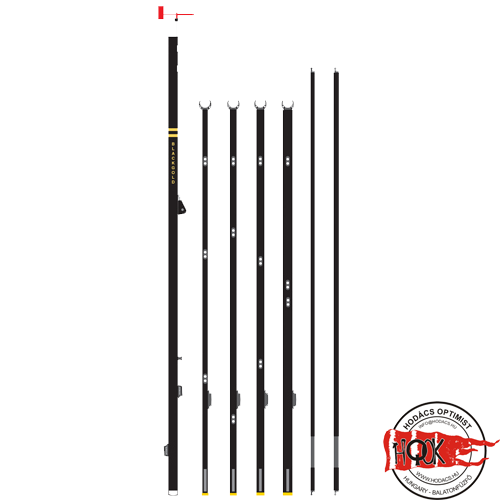
This Optimist spar set is for sailors above 45kg. The set contains: - BlackGold Power mast- BlacGold Power boom (45mm)- Blackgold Medium Sprit (27mm) Also inclusive rigging pack: - halyard system with Dyneema® halyard line - harken hook-in block - Windesign low friction ring, - PRO wind indicator - top pins - sprit halyard handle - mast sleeve. BlackGold mast informations:The Blackgold collection contains three types of spars. The regular BLACKGOLD Power mast which is suitable for sailors above 45 kg, the 12% more flexible BLACKGOLD Medium mast and the most flexible BLACKGOLD Lite mast which is 20% more flexible compared to the BLACKGOLD Power. All three are 45 microns black hard anodized 7075 masts and come with high grade nylon fittings and hard anodized cleats.

Stainless steel lock to secure your mast from coming out of its step when the boat is capsized. Prevents costly foredeck damage. This lock has a rubber insert and should be clamped around the mast just under the deck.We suggest to use the collar in addition to the rope locking system to create double security. Supplied with a line to attach it to the maststep.
