How has optimist participation changed over time at the Hungarian Nationals
Hello everyone!
I knew this post would take a lot of time, but I didn’t realize just how much! Despite that, I think it was worth it. I encourage you to read through the entire post —it’s packed with insights.
Nowadays, data is often called the "new gold." Everyone is building, editing, and analyzing databases, tracking cookies and user behavior. My goal wasn’t to follow trends, but simply to explore what insights could be drawn from decades of archived Optimist championship results that were still available.
On the Optimist.hu website, there’s a table of Optimist champions from 1974 onward, recording the top three youth and junior finishers each year. It’s an excellent collection, initially based on a special issue of Vitorlázás Magazin. Since the early 2000s, I’ve been updating the results myself. However, to answer the questions I had in mind, this data was insufficient as I needed the complete rankings.
So my first step was to visit the Association, where I found the championship results from 1986 onward. These were all on paper, so I spent a few hours digitizing them. The most thorough approach would have involved OCR scanning, but I didn’t go that far.
Fortunately, since 2004, I’ve been collecting the rankings myself, so I only needed to scan the 1986-2004 period. This was the easy part. Afterward, I had to evaluate the rankings based on the questions I had formulated, which would have been much simpler if the data had been properly digitized or retyped. With 32 years of championship results, here are the main questions I aimed to answer:
- Changes in participation numbers
- Number of participating clubs
- Changes in the ratio of cadett/junior sailors and boys/girls
- Frequency of hosting locations
- Percentage of foreign participants
- Some interesting records and notable achievements
Analyzing data can yield all sorts of interesting information, but I hope my analysis is not just "fun trivia." I tried to include some useful insights, but my main goal was to provide factual support for some commonly held beliefs.
Digital records are more likely to exist in multiple copies, but there are fewer copies of older paper records, and they risk deteriorating. Going back to the mid-1980s, many results are handwritten and would require an experienced sailor to interpret even if they were digitized.
If the Association could take on the task of digitizing these records—at the very least by scanning rankings and championship results as images—it would be a significant step forward! This could also be done at the club level, helping the Association and preserving records that may only exist in physical archives.
What 32 Years
of Optimist National Championship Data Shows
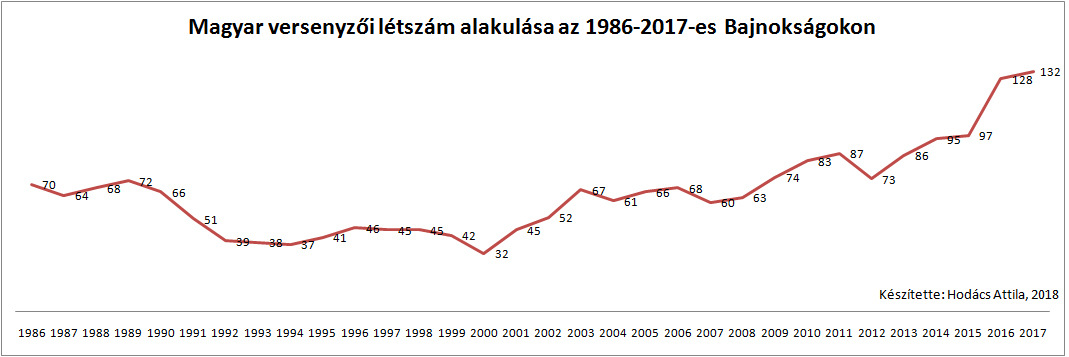
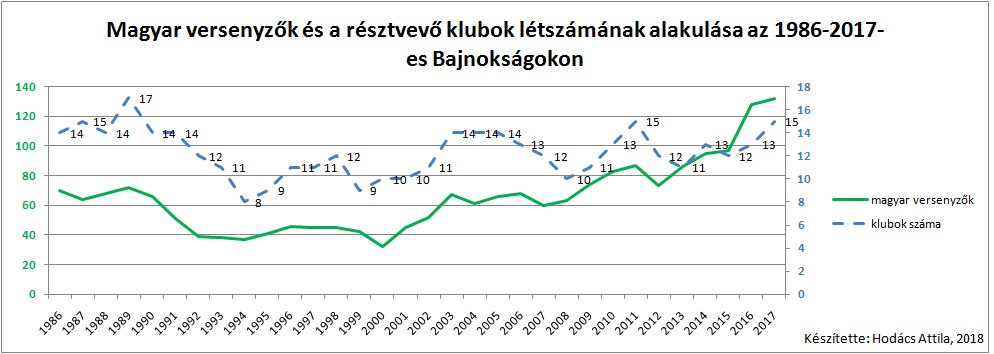
The first chart illustrates changes in the number of Optimist competitors over time.
In the 1990s, there was a sharp decline, likely due to the shift from state funding to private sponsorship. Fortunately, since the 2000s, numbers have been on a steady rise, despite some fluctuations. Possible reasons include the growing popularity of sailing, improved club programs, and increased club and private training opportunities—or simple demographic growth (I haven’t cross-checked population data).
A few years ago, when participation reached 80 sailors, many claimed it was a record number, though the late '80s also had similar numbers. For example, at the 1987 Szobi Cup, there were 86 entries, 12 of whom were foreigners.
While I didn’t compare growth to demographic data, it’s worth examining how the number of clubs involved in Optimist sailing has impacted participation. There’s a strong correlation, with the number of clubs closely mirroring participant numbers. Recent years have seen more club-level coaches, and it’s likely that each coach manages around 8-10 sailors at most.
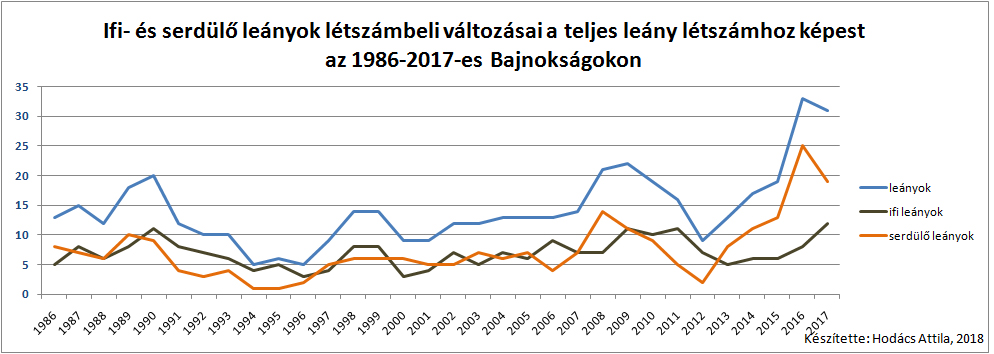
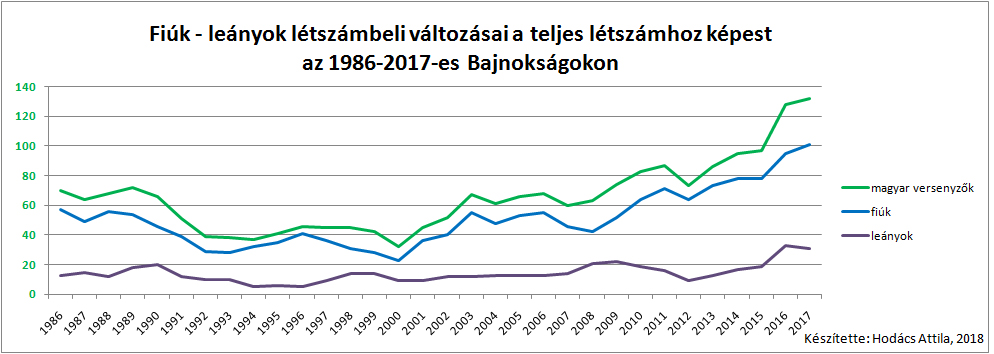
The ratio of boys to girls is always interesting. In recent years, girls have been doing well, with a separate category for girls’ champions. Still, there’s room for improvement, as the boys’ participation curve aligns more closely with the overall participation trend, showing that boys’ numbers have a stronger influence.
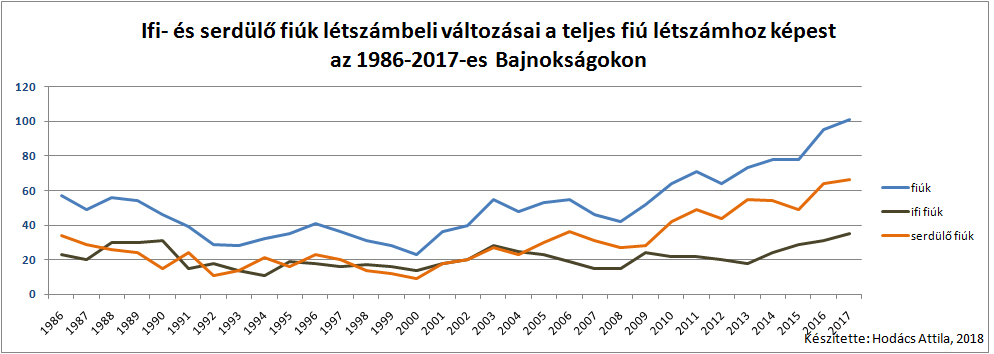
In terms of age groups, since 2005 (especially from 2010), cadetts (under 13) have been roughly twice as numerous as junior sailors (13-15). This suggests that sailors spend around 3-4 years competing as cadets, while most spend only 1-2 years in the juniors category before moving on. In Optimist terms, this means there’s either a high dropout rate or transition to other classes around this age.
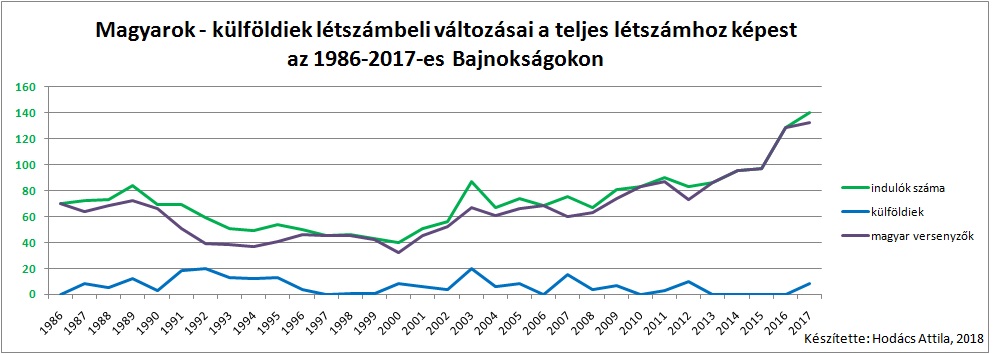
Foreign sailorss have won the Hungarian Championship five times over the past 32 years: twice by Czechs, twice by the same Slovak sailor, and once by a Dutch sailor. While this reflects a strong defense of the national title, foreign participation in the championships is still low. Despite some international success that could attract more competitors, the Hungarian Championship (OB) is not particulary popular among foreign sailors. There are often schedule conflicts, but promoting the Nationals more actively could be beneficial.
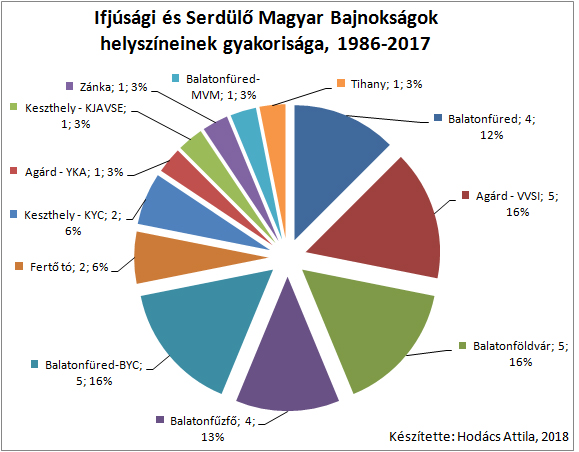
While analyzing the data, I was curious to see which locations or clubs have most frequently hosted Optimist Championships over the past 32 years. The chart highlights each location’s share of total championships hosted, noting that some events were organized jointly between Füred clubs and the Association.
Notable highlits from 32 years of Data
I also dug into some record-setting achievements.
Most National Titles Won by Sailors
It’s a significantachievemnet to win even two titles, but a few sailors managed to
win three or four titles during their Optimist years.
|
Year |
Name |
Number of Titles |
Titles as Cadett |
Titles as Junior |
|
2000-03 |
Imre Váradi |
4 |
3 |
1 |
|
2006-09 |
Benjamin Vadnai |
4 |
2 |
2 |
|
1988-90 |
Tamás Eszes |
3 |
1 |
2 |
|
1993-94,97 |
Attila Hodács |
3 |
2 |
1 |
|
1999-2001 |
Zsombor Berecz |
3 |
- |
3 |
|
2013-15 |
Máté Jeney |
3 |
3 |
- |
Lowest Score National Champions
These sailors won their championships with the lowest possible score, having
won every race that counted toward their final result.
|
Year |
Name |
Placings |
|
1989 |
Tamás Eszes |
1*,1,1,1,1,1 |
|
1997 |
Attila Hodács |
1,1,1,1,1,2*,1 |
|
2016 |
Attila Bányai |
1,1,1,1,2*,1,1,7*,1 |
Best Female Results
Here are the top finishes by female sailors, showing that a record from 1987 is still waiting to be broken by today’s female sailors!
|
Year |
Name |
Overall Position |
|
1987 |
Bernadett Eszes |
1 |
|
1986 |
Bernadett Eszes |
2 |
|
1988 |
Krisztina Bácsics |
2 |
|
2003 |
Réka Karácsony |
2 (6*) |
|
2007 |
Fanni Péch |
2 |
|
2014 |
Csenge Veenstra |
2 |
|
1990 |
Márta Weöres |
3 |
|
1993 |
Gabriella Adlovits |
3 (4*) |
|
2008 |
Fanni Péch |
3 |
* Includes foreign competitors.
Best Junior/Cadett Results
Cadett champions generally finish in the top 1-10 of the overall standings,
though some have finished outside the top 10. Here are a few cadetts who also led
the overall standings.
|
Year |
Name |
Overall Position |
|
1986 |
Zsolt Gömöry |
1 |
|
1991 |
Ákos Gyenes |
1 |
|
1998 |
Bálint Bors |
1 |
|
2007 |
Benjamin Vadnai |
1 |
|
2014 |
Máté Jeney |
1 |
|
2016 |
Attila Bányai |
1 |
Summary
In today’s data-rich world, taking time to
analyze information is worthwhile, as it can reveal valuable insights. I’ve
uploaded the results here, and believe the Association's website will also host
them. Several result tables also contain championship results from other boat
classes, so feel free to browse and take a walk down memory lane!
Sources
The original 1986-2004 results can be found at the MVSZ office, with the
exception of 1998, courtesy of János Karácsony. Thank you to István Hantó for
verifying the 1992 list by age category, and to Makusz and Bozó for their
research. The 2005-2017 lists come from my personal archive.
Note from My Personal Archive
The 2005-2017 results come from my personal
archive. As a side note, my curiosity got the better of me, and although this research
took a freat deal of time, it was truly uplifting. Going through these rankings,
seeing the names of sailors who are now parents with their own children sailing
Optimists, felt like watching the Optimist sailing journeys of these
individuals unfold before my eyes. Reading trough the results, I relived close
championship finishes decided by single points, long-standing rivalries, and
the sudden emergence of new talents. It was truly a joy to revisit!
Boat Class Participation by Year
|
Year |
Optimist |
Cadet |
Moth |
Europe |
Laser 4.7 |
Laser Radial |
Laser |
S-Yolle |
Snipe |
Zoom8 |
420 |
470 |
Kormorán |
|
1986 |
X |
X |
X |
||||||||||
|
1987 |
X |
X |
X |
||||||||||
|
1988 |
X |
X |
|||||||||||
|
1989 |
X |
X |
|||||||||||
|
1990 |
X |
X |
|||||||||||
|
1991 |
X |
X |
X |
X |
|||||||||
|
1992 |
X |
X |
X |
X |
X |
X |
X |
||||||
|
1993 |
X |
X |
X |
X |
|||||||||
|
1994 |
X |
X |
X |
X |
X |
X |
X |
X |
|||||
|
1995 |
X |
||||||||||||
|
1996 |
X |
||||||||||||
|
1997 |
X |
X |
X |
||||||||||
|
1998 |
X |
||||||||||||
|
1999 |
X |
X |
X |
||||||||||
|
2000 |
X |
X |
X |
||||||||||
|
2001 |
X |
X |
X |
||||||||||
|
2002 |
X |
X |
X |
||||||||||
|
2003 |
X |
X |
X |
||||||||||
|
2004 |
X |
||||||||||||
|
2005 |
X |
X |
X |
X |
X |
||||||||
|
2006 |
X |
X |
X |
X |
X |
||||||||
|
2007 |
X |
||||||||||||
|
2008 |
X |
||||||||||||
|
2009 |
X |
||||||||||||
|
2010 |
X |
X |
X |
X |
X |
X |
|||||||
|
2011 |
X |
X |
|||||||||||
|
2012 |
X |
X |
X |
X |
|||||||||
|
2013 |
X |
||||||||||||
|
2014 |
X |
||||||||||||
|
2015 |
X |
||||||||||||
|
2016 |
X |
||||||||||||
|
2017 |
X |
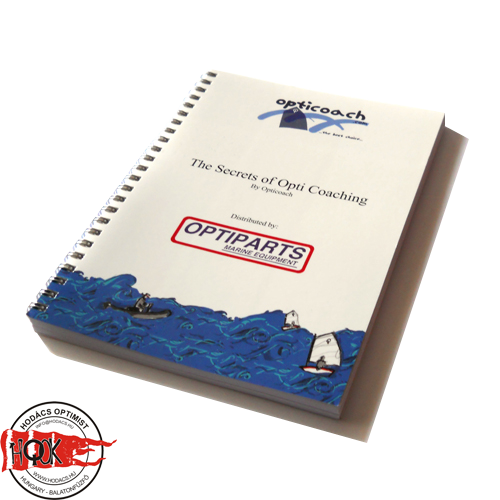
Attila Hodacs reveals 20 years of his coaching experience in this 85 page book. Includes phases of development, how to lead sailors to international level racing, setting up training sessions, how to improve boathandling, strategy and how to minimize mistakes. A must have for every trainer, coach and interested parent.