
Why optimist boats accidentally turn into the wind?
Rudder vs mainsheet - understanding proper control
Hello everyone!
I’m still working on the next article (it’s quite a big project), but to keep you from waiting too long for something new to read, I thought of a topic that often troubles sailors: unintentionally heading into the wind. This is a common, complex issue that I believe is worth examining closely.
This situation mostly happens to beginner sailors who are still mastering upwind sailing, especially in stronger winds. Facing this challenge is part of the learning curve, so encountering it is practically guaranteed. The real question is how quickly you can learn to handle it effectively.
The Complexity
of Upwind Sailing in Strong Winds
Upwind sailing in strong winds requires executing each movement precisely. This is particularly challenging because our local lakes often experience lighter winds, especially in summer. Lighter winds allow for more margin of error, as minor mistakes in control often go unnoticed. However, as the wind picks up, imprecise actions become magnified, exposing any weaknesses in technique. Consider maneuvers like turning, gybing, or even bearing away from upwind or from a close reach; these actions all demand more precision in strong winds.
What to Pay
Attention to When Sailing Upwind
When sailing upwind in strong winds, several elements require continuous attention:
- Body movement,
- Steering control,
- Mainsheet handling,
- Changes in wind strength,
- Sail trim,
- Maintaining sharp reflexes and focus.
Understanding
Why the Boat Turns into the Wind
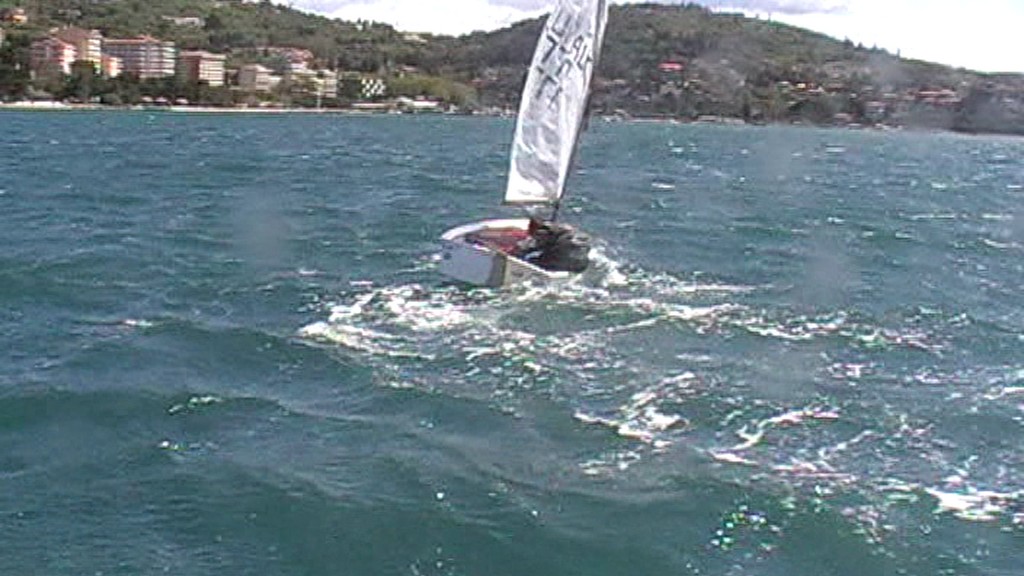
A boat turning into the wind is usually the result of multiple factors occuring in sequence. Although many sailors understand the mechanics, reflexes often lead them to respond in less-than-ideal ways. Let’s break down the process, which we’ll review with the help of two example videos.
- The sailor is hiking upwind — they could be hiking further out, and the sail could be trimmed flatter.
- Their attention should ideally be forward — watching the water surface to anticipate gusts.
- A gust arrives.
- The sailor can’t quite counterbalance the stronger gust, so the boat heels more; this is natural for beginners still developing weight and experience.
- As the boat heels further, it naturally begins to head into the wind.
- To avoid heading up into the wind, the sailor steers to compensate.
- This counter-steering places the rudder at an angle, which acts as a brake.
- The boat naturally wants to point up, but the sailor tries to bear off, resulting in a loss of speed and the boat eventually stalling head-to-wind.
- Sometimes, this sequence leads to an “involuntary tack,” where the boat ends up on a new tack but with the same problem potentially repeating.
Analyzing the
Video
Here’s a video that illustrates the sequence. Initially, watch it simply to observe what happens.
- First Video: [Link to video]
Now that you have an overview, here’s a step-by-step analysis in a slowed-down video.
- Second Video: [Link to video]
Key points in the video:
- “Watch out, a gust is coming” — You can see it on the water, but the sailor doesn’t anticipate it, so the boat heels more sharply.
- “Ease the sheet” — The gust overloads the sail; instead of counter-steering, the mainsheet should be eased to release excess power.
- “Too late” — The boat inevitably ends up head-to-wind.
- “Automatic tack” — This often feels like a way out for sailors but can lead to another iteration of the same problem.
- “Ease the sheet again” — After the tack, the problem often persists; the sheet must be eased to regain control.
In some cases, the Optimist ends up fully head-to-wind and begins drifting backward. In this situation, the sailor needs to sit in the boat, push the tiller to the opposite side, and ease the sheet significantly. The boat will begin to drift backward until it reaches a beam reach position, where it can resume normal upwind sailing. A common mistake here is not easing the sheet enough, so the sail catches wind too soon, and the boat points back up into the wind.
The earliest opportunity to recover from this situation would be Step 6 — instead of counter-steering, easing the sheet would have been the solution. When the gust hits, it overpowers the sail, creating too much force for the beginner sailor to handle. When the wind is too strong, there’s no need to keep all that power in the sail.
Often, inexperienced sailors tend to rely solely on the rudder, thinking it’s the only way to control the boat in such situations. However, both the sheet and the tiller are essential, with one hand controlling each, and both need to be adjusted dynamically.
The best point to start preventing this issue would actually be Step 2. When a gust approaches, the sailor should immediately lean out more or, if they’re already at their maximum, ease the sheet as soon as the boat starts to heel further. Once the gust passes, the sail can be trimmed back in again, and upwind sailing can resume.
Summary
The sheet and tiller are there for a reason, and
both should be used, especially in strong winds, to work in balance. By
consistently adjusting both, with one hand pushing and the other easing, you
maintain full control in all wind conditions.
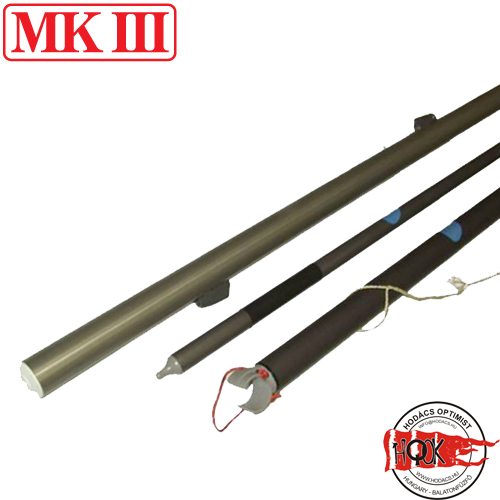
This optimist spar set from Optimax spars is for midweight optimist sailors 35-45kg. Complete set of optimist rig with following items: - Optimax MK3 mast - Optimax MK4 boom - 45mm - Optimax MK3 sprit (as standard, or choose one )For the same price the sprit choice is yours, just write it in the order comment: MK3/MK3Flex/MK3Hyperflex Also inclusive rigging pack with: - 2x Nylon top pins - 1x Harken ball bearing hook-in block - 1x Windesign wind indicator PRO - 1x Windesign 25 mm low friction ring - 1x Nylon sprit adjuster handle - 1x 3 mm Dyneema halyard line - 1x 4 mm halyard line - 5x 2.2 mm tack lines - 12x 1.2 mm double lacing lines - 1x Deck collar with mast sleeve.
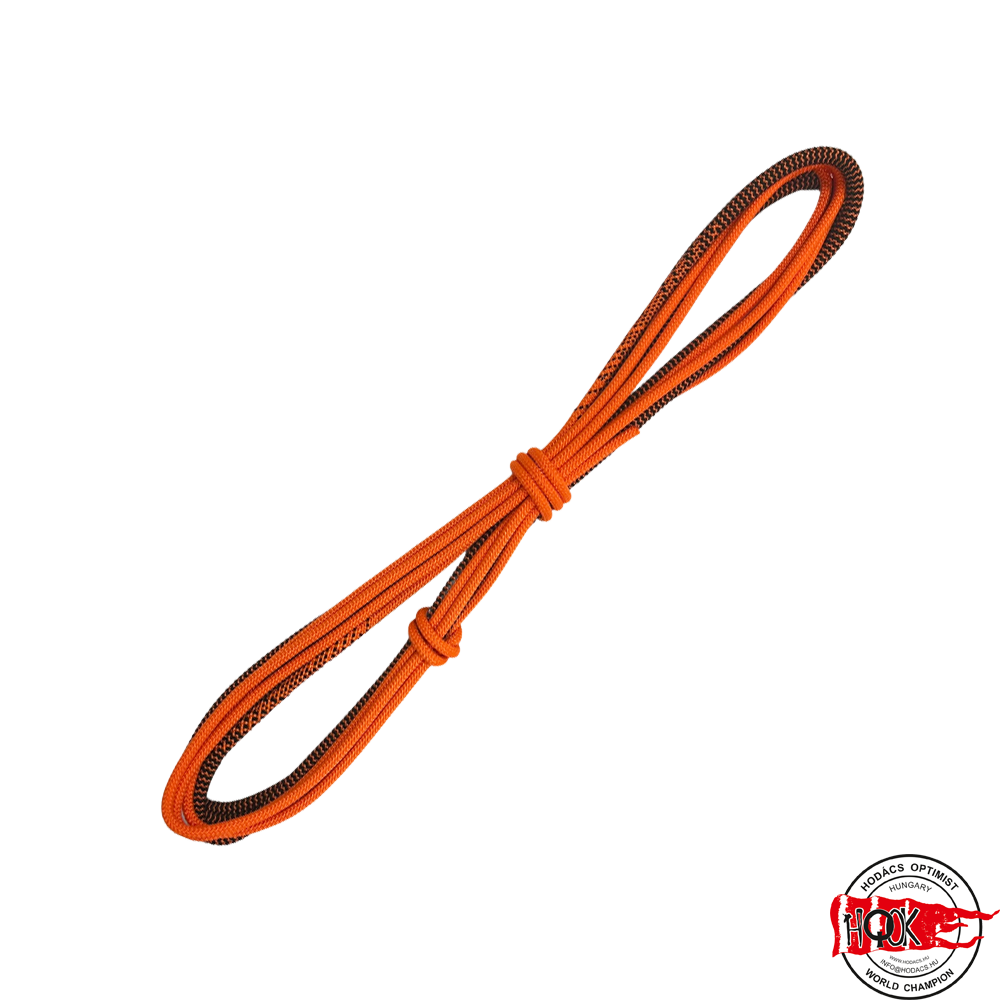
Designed specifically for Optimist sailors, this new mainsheet is ready to go — just tie it at the thinner end for a 3:1 or 4:1 setup and hit the water! The improved length ratios ensure that upwind, the thicker, more comfortable section sits perfectly in your hand, while downwind the tapered section automatically takes over for smoother trimming. The 8–6 mm rope combines a lightweight HT polyester core with a soft, cotton-feel cover, offering both strength and comfort. The tapered ends reduce weight and allow the sheet to glide easily through the blocks.Length: 7 m Diameter: 6–8–6 mm Material: HT polyester core with a polyester/cotton outer cover.As with any mainsheet, friction between the blocks and rope is natural and may lead to wear over time, especially when the ratchet is engaged.
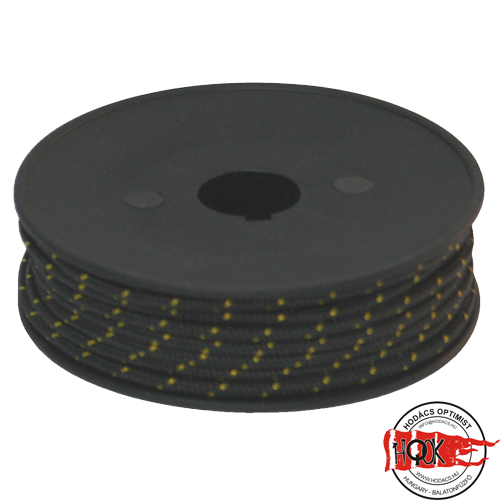
Compact 2,2 mm black Vectran line with gold fleck, designed for Optimist corner ties. Strong, low stretch, and 2.2mm Vectran minireel; 8meter long.
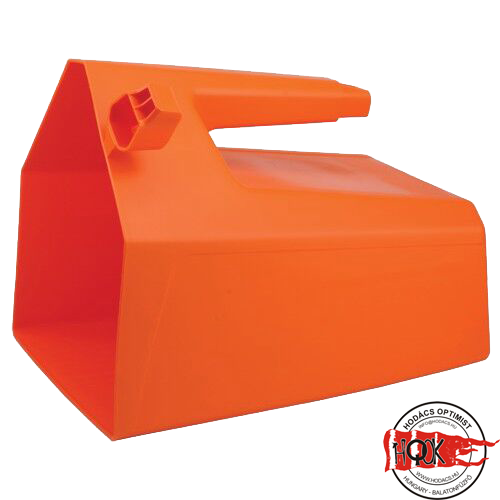
Large, lightweight and durable handbailers. The wide ergonomic base creates more bailing capacity with each stroke, the curved bottom to follow the bailing motion and a triangular top so you don’t get stuck behind the gunwale. High handle with end stop to prevent slipping out of your hand, with integrated shockcord fastening. Reinforced wear areas, rounded front lip and stackable for transportation. Length 24cm, width 17cm.